All posts by Reina Hoctin Boes

Unknown's avatar

About Reina Hoctin Boes

I rely on e-motion. It's not about the smileys. And yet we live in a digital era where our emotions seem to be annoying attributes to life. Restrained, carefully chosen events to move our senses, are okay. We like to buy our emotions: food, dating sites, concert tickets. The fair exchange for money gives a sense of control over our emotions. Because what if, we freely open up, expose our senses on a daily basis to all that comes around? It means vulnerability. Do we really want to go there? Or do we rather read or fantasize about it? The second part of my life I wish to dedicate to the senses. And as such I'll be re-exploring reality. We say this moment is our life. What is it that this moment beholds? I reckon we haven't got a clue to find out what this moment beholds other then our five senses.

Wholesome

Recently a friend and me had lunch at Lavinia, a lunchroom at the Kerkstraat. Which happens to be the longest street of Amsterdam city centre, hidden between Prinsengracht and Keizersgracht. Lavinia serves mainly vegetarian food, including vegan options and modernistic responsible-food-products like packaged coconut water and UTZ certified chocolate springles. My friend the other day dropped the expression New Foodism. If there’s any such thing, Lavinia has it.

Sustainable and vintage furniture, tap water garnished with citrus fruits and mint offered for free at the counter, intelligent waitresses and more vegetarian options at the menu then fishy or meaty treats. However my friend and me like to look beyond the idea of wholesome, well sourced ingredients and a hip and going environment. What’s it really all about? Like the purpose, meaning and destiny of life we constantly keep asking ourselves about or if we’re not in the spin of this mind-full-ness, being in doubt whether we should actually better be asking ourselves these deep questions instead of simply living the moment.

The difference between questions, doubt and awareness is quite an item which I gladly leave for another post. For now I’d like to keep things close to Lavinia, her food and it’s surroundings. Over a year ago my friend and me independently choose to pursue a vegan life style by skipping diary, fishy and meaty products from our menus. On the side I also rather not digest refined sugar, gluten and nuts. However I do prefer leather shoes and woolen sweaters over synthetic material to address yet another complicated matter of assimilation and appearance. Anyway it’s an entertaining challenge to find out who’s able to cater for our pretty demanding food preferences. My friend questions his vegan lifestyle once in a while. He especially did during the holiday season. Not because, finding himself in Manchester for Christmas, he missed out on the turkey and scrambled eggs with bacon for breakfast. But merely because he doesn’t want to be a pain in the ass for his hosts. Social wise, to confess being vegan – if only it were for the mere pronunciation – isn’t typically easy going. Your food-loving host prepares an excellent and entertaining diner and you act like: “No thanks, I do not eat – as in appreciate – your efforts. But don’t you worry about me”. And that’s exactly what they’ll do the rest of the evening. Worrying and talking about your a-typical food preferences. Deep apologies dear hosts. We’re not here to harm you.

To our unexpected surprise electing a dish from a menu in regular restaurants actually more often then not is a simple task. On average there’s just not so much to choose from. Which makes it easy. A vegan burger nowadays has found it’s way into many a restaurant. It often isn’t the most seducing or appealing item at the menu. You might even rather skip the whole restaurant experience all together, visit your local farm shop instead, buy some real wholesome and good ingredients and cook yourself. However not having to choose really does make life simple once in a while.

Fortunately Lavinia at the Kerkstraat offers a different experience. The intelligent waitresses eagerly inform themselves in the kitchen upon our question if the pick-your-own choice-of-three from the salad station could possibly behold a vegan lunch option. They proudly return with the happy notice that this can be done. Which is great of course. The cakes and sweets I love to indulge unfortunately all contain refined sugar. Which disappoints slightly because the expectations are held high through the Lavinian outlook of things. Tea is to be infused in the form of a simple teabag. Which isn’t very lucid either with even a professionally commercial chain like the Coffee Company serving subtle and refined tea made from bold leaves transferred into individual paper bags with loving care and attention by the barristas.

The Lavinian experience in particular makes us wonder if indeed we’re all still very much attached to the idea of purchasing a package deal while eating out. It’s about what you find at your plate, of course. But we’re comfortably used at paying the bill for the way the food is presented, for the ambiance created for us, including some not very professional but charming gestures or words of the waitresses. I am not judging this predisposition of ours. I am just trying to make it clear to myself and others. The same way as I tend to check the list of ingredients on almost every jar or pack I grap from a shop shelve nowadays. What am I buying? I need glasses to make it clear to myself. But it isn’t the glasses that clarify it. It’s the act of being conscious of it.

And so it is with our restaurant bills. We find it romantically nostalgic if in France the ‚couverts’ are being charged seperately at € 1 per head. We check if the service is included or not before adding a pourboire (tip) to l’addition (bill). I’m starting to realize the truth of this basically very realistic custom. It makes me come up with the idea of a new Amsterdam way. A place where it is specified at your bill what you pay for. Apart from charging the custom couscous with pomegranate, spicy pumpkin soup and two jasmin tea’s, the bill specifies separately for x-amounts: special Monday ambiance; José’s service; vintage tableware and the chefs ‚made with love and attention’ label. Because in most of the restaurants and places you’ll find yourself nowadays, that’s what it is all about. Entourage, feeling, ideas and idealism or what you see is what you get. Do not go beyond, do not pass the borders of our communal comfort zone while sullenly enjoying the moment.

Free of

Which content to share first? The exploration of free-of-animal-products-lunch-options in Amsterdam? An adventure an old friend of mine came up with. Like myself, he turned vegan almost two years ago. We share our experiences over vegan or even raw cheesecakes, banana bread and complete gourmet lunch deals. Appetizing yet remarkably more difficult to pursue then one would believe in the free-est city of all: Amsterdam. Really exploring a certain field needs persistence. We set out primarily every other Wednesday. This might change to every other Thursday. Along side persistence features structure. Indispensable assets to take off with.

The other interesting subject I am longing to share with you is a small little treatise on the difference between attachment and connection. This is more of a group travel. It’s the first time for me to make up my mind about the difference between attachment and connection. To do so I’d better be in your presence. If not I risk loosing track. The suspected major importance of the difference between attachment and connection (attaching an electric wire, plugging in for connection) holds me back a bit. I feel it to be difficult to grasp it’s full meaning. As opposed to the adventure that evolves around the ‘free of’ food-trip. Simply drawing upon some sort of rationalistic point of view and behaviour guided along a clear – free of – etiquette. Or isn’t it that simple? Am I oblivious of the important subconscious impact my friend and me make by eating vegan and the drive we feel to follow it through?

Let me quickly share some first results of our comparitive research into the vegan lunch options, just to give you an idea. After having had lunch at Dophert, Wagamama, the Alchemist Garden, Deshima and Lavinia -all being day time restaurants located in Amsterdam and offering good lunch options, we agreed upon the best lunch deal at Deshima. We do not take into account the bill. Price-quality relation isn’t the first thing to consider in this new type of sports. We take into account: the quantity of vegan options at the menu, the genuineness of the chefs’ vegan drive, the authenticity of the ingredients and the energy we got from the food and it’s location. We discovered ‘the Amsterdam way’ isn’t appealing if it comes to vegan cooking in particular or serving food in general. We feel best if our servings are honest and made with an amount of knowledge, love and attention that surpasses our own. The establishments with a kind of non-commercial feel, really focusing at the food, in an environment that’s not exactly cosy, hip or outstanding we like best: Deshima and Alchemist Garden. Lavinia makes a nice day break by presenting their products and menu in a customer friendly way, up to date yet low profile. Unfortunately the so called Amsterdam way rules. The awesome looking cakes at Lavinia all contain refined sugar. So far for the outcome of the research into vegan lunch options.

‘Free of’ features easily as the main adjective for 2015. The best adjective according to my humble opinion being no adjective at all. Free of as an adjective is coming close to this minimalistic best. There’s all kinds of free from. Free from as opposed to free form, is restrictive, bordered and contains a lot of no’s. Instead of freely forming – or going with – the flow. Alas! we do no longer go with the flow.

Yet at the same time we’re meant to accept all that is. No no’s, no resistance. At least that’s what mindfull or wise people are telling us. Forget your ego, don’t let your mind rule your behavior. This contradicts big time our efforts to live consciously by saying no to almost everything our bodies crave for. Or does it not? Acceptance versus resistance: it leads me to grasp for a solution hidden in the difference between being attached and being connected. Saying no to the good taste, nice textures and satisfaction derived from animal products, results in testifying to me and others that I am not attached to these animalistic seductions. Instead I connect to my body. If I really connect to my body without the fear of loosing what I like – being attached – I find out what I really need. However if then I discover the body cries for ice cream, red wine and sashimi, I am set back. The mind says: ‘that’s wrong!’ To make things even more complicated, we get to the explanation that if the body yearns for unhealthy stuff, it means the body is not in balance. Would it be in balance, it would crave for mere water when thirsty and carrots or beans when hungry. Pretty daunting and much of a disillusion after having prioritized food in every possible way for the past thirty years.

Where’s the exit? Experience! To go through it all. To find out that listening to my body doesn’t actually start with listening to my body. Conscious living and eating both start with the mind. Hence mindfulness. First I tell myself or let others and pseudo-scientific studies tell me, what is good or bad for my health. A good first step into this thousand miles journey is for example: Timeless secrets of Health and Rejuvenation by the late Andreas Moritz. The journey continues by saying no to almost anything that is easily available, palatable and payable. Hence the exploration of alternative, macro-biotic, ayurvedic and vegan fields to find out what suits my taste. Then developing proper recipes, creating a personal daily routine and new cravings. Along the way this most exciting revelation pops up: I can actually make the body crave for green tea and date balls covered with shredded coconut instead of glasses filled with Sauternes accompanied by butterscotch chocolate, not to mention the terribly wrong foie gras. It takes a couple of years and a lot of don’ts. But it works!

After all I am not so sure if real connection is coming in. I’ve merely just changed my patterns and habits. Because the mind and others made me believe my former patterns and habits were unhealthy, making me stressed, tired and old. I was able to transform my attachments. Which is an important step into the direction of being freed from attachments. But it isn’t the same thing. Sometimes I really am able to feel the body, to connect to it. The funny thing is, when it happens, I am happy. The inner body doesn’t talk back telling me what to resist.

With special thanks to my friend Michiel Oudakker and awesomeamsterdam.nl

Kerst + mis = zandkasteel

Zes uur ‘s avonds op de fiets, uitwaaien op de boulevard langs het strand van Barcelonetta. Het is nu echt wel koud. Aan het begin van de middag zaten we op een terrasje in de zon. Na een half uur ging mijn trui uit en zat ik met blote armen. Heerlijk. Nu is het Spaans koud, scherper of killer dan in Nederland. Flaneren op de fiets is toch fijn. Een beetje een show off hier. Als je fietst in plaats van wandelt over de brede paseo’s en promenades. Fietspaden zijn er nog weinig. Een fietsbel gebruik je niet. Daarmee jaag je voetgangers angst aan. Al fietsende ben jij degene die goed uitkijkt en uitwijkt. Rechtvaardigheid is hier niet zoals in Nederland het recht van de fietser.
We stappen af bij een indrukwekkend kunstwerk dat is gebeeldhouwd uit strandzand. Compleet met een fonteintje en vuur. Het is prachtig. Een stukje verderop nog één. Nadat we wat kleingeld in de kartonnen doos die daarvoor bestemd is hebben gedeponeerd, zeg ik ‘feliz navidad’ tegen de vrouw die er met een blikje bier naast zit. Ze kijkt me vragend aan en ik herhaal de kerstwens. Ze zegt ‘gracias’ met een zwaar accent. Ik vraag haar: ‘de donde eres?’ terwijl ik me het lot aantrek van iemand die op eerste kerstdag hier zit met een biertje op het koude strand van Barcelona naast een kartonnen doos met wisselgeld. ‘De Holanda’ zegt ze en ik vraag haar of zij het zandkasteel gemaakt heeft. Onduidelijk en moeilijk uitgesproken woorden die vertellen dat haar vriendje dat heeft gedaan, zij de wacht houdt, hij moet ook weleens plassen weet je. Het praatje wordt door mij kunstmatig verlengd. Totdat ik me weer omkeer naar mijn leven en haar achterlaat in haar bestaan. Tsjee, kerst denk ik. Wat ‘n ellende.
We trappen wat harder door, scheren soms rakelings langs wandelaars op de boulevard, om te eindigen bij een leuke tent aan het strand. El Chiringuito waar het zomers te druk is om een tafel te bemachtigen, maar waar we nu royaal plaats kunnen nemen op het overdekte terras onder de warmtelampen: ‘life is good at the beach’ is de tegeltjeswijsheid die ergens aan de wand prijkt. We bestellen thee en Torta de Santiago als stille troost voor het misse van kerst-mis.

Wonderland Revisited

IMG_0860.JPG
{Afbeelding van Piet de Loof, Sneeuwwitje}

Rood is de kleur van liefde en zwart die van de dood. Rood en zwart zijn samen flamenco en duivels. Weet ik. Wie niet? Weten en (in)zien zijn alleen niet hetzelfde. Vannacht ervoer ik plotseling een inzicht. Ik zeg nogal pathetisch ‘ervoer’ in plaats van ‘had’ omdat ik dat inzicht duidelijk niet te pakken had, het had mij te pakken. Willie Wortel duidt zijn vorm van verlichting aan met een gloeilampje. Dat is grappig maar niet alles omvattend. Inzicht is meer dan een geestelijk-verstandelijke aha erlebnis. Ik voelde het.

Is dat alles? Voelen!

Pooh, het mag duidelijk zijn. Ik leg het niet zomaar even uit.

Om kort te gaan: kleuren kwamen tot leven. Ten overvloede voeg ik hieraan toe dat er geen hallucinerend middel aan te pas kwam anders dan mijn eigen thèta state of mind. Een schemer of lucide staat waarin hersengolven niet frequent zijn en hersenactiviteit laag is. De deur tussen bewust- en onbewustzijn staat wagenwijd open. En opeens begreep ik werkelijk waarom bijvoorbeeld een klein meisje hoort bij roze. Ze houdt van deze vermenging van maagdelijk wit en liefdevol rood omdat ze het herkent. Ze herkent haar eigen onbevangen kleurenmix van witte spiritualiteit en rode liefde.

Het duivelse van geheimzinnig en occult zwart in combinatie met een beetje emotioneel gevaarlijk rood treft me opeens. Diepe gevoelens horen bij zwart en dan is de verrijking met een gepassioneerd rood detail tegelijk zo afstotend en aanlokkelijk als spiritualiën zijn: dubbelgedistilleerde Eau de Vie en andere desastreuze levenselixers.

Voor het raam waar ik zit te schrijven steekt een grijsharige vrouw het zebrapad over. Ze draagt een lange zwarte jas met een rode sjaal. Diepzinnige mensen dragen zwart. De tango is zwart van diepgang en beslotenheid. A little black dress is een geheimzinnig omhulsel. Veel zwart met een beetje rood is duivels; occulte diepzinnigheid met passie vanuit het hart. Flamenco is in balans qua zwart en rood en een stuk levendiger dan de zware en zwarte Portugese fado. Rauwe stemmen alom weliswaar. En dan veel rood met maar een beetje zwart. Daar neemt passie de overhand en is het niet langer zwaar, diep en gevaarlijk. Dat heet pikant.

Rood en wit samen geeft opeens een heel ander beeld met een heel ander gevoel. Het Rode Kruis: een liefdevol kruis op een spiritueel witte achtergrond. Zo had ik dit ijzersterke embleem nog niet bekeken. Het vormt een fikse tegenstelling met de verleidelijk zwart met rode Can Can dansende dames van plezier in de Moulin Rouge. The Red Light district is rood met zwart, niet rood met wit. Add another color and the picture completely changes. Or so it seems.

Bloedrode lippen met een sneeuwwitte huid en haar zo zwart als ebbehout, dat is waar ze samen komen. Waar rood, wit en zwart blijken te staan voor een perfecte drie-éénheid. Een volmaakt vrouwelijk evenwicht dat niet bestaat uit onze hedendaagse tweedimensionale balans zonder diepgang. Waarbij het vrouwelijk ideaalbeeld draait om liefde en spiritualiteit zonder zwarte modder. Dat is althans waar het onwetend vrouwelijk ik naartoe wil. Een blanke geest en een gepassioneerd hart, ongeaard en zonder rommel.

Dit in tegenstelling tot het veel minder bewust tot stand gekomen huidige straatbeeld waarin vrouwen hoofdzakelijk zwart dragen en andere donkere, grijzige, modderige tinten aangevuld met een clandestien rood sjaaltje. We oefenen graag de lotushouding. Het liefst met wijsvinger en duim gevormd in een perfect cirkeltje, omhooggericht, met de rug van de hand rustend op de knie. Beide knieën zijn op hun beurt allebei zo geknikt dat ze de ultieme vorm van een overtreffende trap van de kleermakerszit bereiken. I’ll show you how perfect I am. Maar perfectie zit ‘m niet in het ontbreken van imperfectie, het zit ‘m in het accepteren ervan.

Als de houding levenloos is, ontbreekt het slijk der aarde eraan. Waar is de drek waaruit die prachtige bloem op-groeide, de foute ellende die ze ont-groeide? Willen we wel weten dat we het roze meisjesstadium achter ons lieten? To not be revisited no more. Zien we wel wat een rijk geschakeerd kleurenpalet ervoor in de plaats kwam? We sluiten liever massaal onze ogen hiervoor om ons te ‘verdiepen’ in meditatieve mijmeringen met wijsvinger en duim in zo’n cirkeltje dat perfectie symboliseert. We willen zijn zoals we waren, een mengsel van spiritueel wit en liefdevol rood, net als toen, onschuldig en gepassioneerd. Want dat is vertrouwd en bekend. Never change a winning team. We hebben onze strijd gestreden. Maar hebben we ook gewonnen? Het is tijd voor een nieuwe outfit dames. Eéntje die ons beter staat dan dat wat we inmiddels lang ontgroeid zijn.

Een werkelijke vrouw zoals je die alleen in sprookjes treft, vormt een drie-éénheid van vlammend rode liefde, maagdelijke witte spiritualiteit én het donkere zwart van de aarde. Dood en verderf en alle occulte geheimzinnigheid incluis. Alleen die vrouw maakt werkelijk verbinding. Connects deep down to where we all come from.

Daar gaat ze, hand in hand met de heilige drie-éénheid van de christelijke God de vader, God de zoon en de Heilige geest (hoe patriarchaal wil je het hebben) verschijnt ten tonele deze matriarchale niet-heilige drie-éénheid (trinidad) van sneeuwwit, bloedrood en zwart als ebbehout.

Thanx dear Alice for quickly revisiting wonderland with me.

Zielig

Ik stort in. En realiseer me dat deze zuivere gedachte just another emotion is. Groot en overheersend. Net zo’n gedachte als ‘het slaat nergens op, laat maar’ of ‘lag ik maar in de zon aan zee met een cocktail in mijn hand’. Maar dan wat meer omvattend. Ik realiseer me tegelijkertijd dat het niet deze gedachte is, die de realiteit vormt. Of het realiteit wordt ligt in mijn eigen handen, mijn eigen doen en laten. Ik kan me fysiek en met behulp van een vliegtuig, wel of niet verplaatsen naar zon en zee en een cocktail bestellen. Ik kan dus ook wel of niet instorten. Dat is, nadat de gedachte is ontstaan, een keus die ik zelf maak. Gedachtes worden realiteit, only when you act accordingly.

Ze kunnen wel hardnekkig zijn, gedachtes. Net zoals emoties. Ook voor emoties geldt: ze worden realiteit if you act accordingly. In mijn privéleven respecteer ik mijn emoties. Dat wil zoveel zeggen als I act upon them. In tegenstelling tot in mijn professionele bestaan waar het in mijn beleving min of meer duidelijk is dat je je niet laat leiden door emoties. Het lijkt alsof mijn privédomein de aangewezen vrijplaats vormt voor emoties. Ik sta daar niet bij stil en denk er niet over na. Talking ‘bout mindfulness. Not! Het betekent dat ik emoties niet onderdruk. Klinkt nogal sixties. Het resulteert jammergenoeg niet in love, peace and happiness. Mijn (ik personaliseer ze) emoties zijn voor mij precious tekenen van mijn bestaan. Ze geven uitdrukking aan mij. Want wat anders? vraag ik me af. Wat of wie ben ik anders dan een verzameling van emotionele, intellectuele en fysieke expressies? Dit onderbouwt mijn verstand gelukkig met de retorische vraag: ‘Hoe stoicijns wil je me hebben? Ik heb net zo veel recht op mijn individueelste uitingen als dat ik recht heb op liefde, aandacht en een (op mij gefocuste) wereld om me heen!’. Dit soort betogingen, daar doet mijn verstand niet moeilijk over.

Ik begin te begrijpen dat emoties en gedachtes niet ik zijn. Ik ben ziel. Eigenlijk weet ik dat al sinds ik een jaar of vijftien, zestien was, dertig jaar geleden nu. Maar tot nu toe leeft de kinderlijke, niet doorleefde wijsheid ervan in haar eigen sfeer. Dat zieltje blijft somewhat theoretisch en manifesteert zich alleen soms onverwacht en ongekend op spiritueel vlak. Als er opeens sprake is van een geestelijk verbond, van onverklaarbare verwantschap, van een out of the blue connectie. Of als ik in een buitenland min of meer gedachteloos een karakertistiek kerkje inloop, mezelf gelukkig prijzend iets mee te hebben gekregen van het katholicisme en dan binnen een kaarsje voor mijn moeder brand. Dan manifesteert zich iets onuitsprekelijks. Ik durf te zeggen dat beide ervaringen met liefde te maken hebben. Als ik ooit nog wijzer ben, zal ik durven berweren dat ze de essentie van liefde uitdrukken: kortstondige ‘aanraaksels’, zelf opgezocht of zomaar erdoor overvallen, van de ziel met haar oorsprong. Maar ik ben te jong nog, om dat al te kunnen onderbouwen. Ook zijn de encounters vooral mysterieus, verleidelijk en bovenal geisoleerd van het dagelijks leven. In het dagelijks leven krijgen intussen gedachten en emoties vrij baan. Waar ze mij te pas en te onpas overvallen. Daar heeft mijn ziel verder niets mee te maken. Hier moet ons woord zielig vandaan komen! De situatie, waar dagelijks leven en ziel geen connectie maken, is zielig.

Cut! Roept het nu. Cut the crap.

Ik werkte lang op de set van commercials. Cut! it’s a wrap betekent dat de opnametijd voorbij is. De opnametijd van het filmmateriaal, of de opnametijd van mij als patient lijdend aan het leven. Alle scenes zitten erop, zowel qua filmmateriaal als die ik in het dagelijks leven maakte. Het is tijd voor editing en montage. Zowel van de beelden die het reclamefilmpje gaan vormen als van de film van mijn eigen leven. Het gevleugelde it’s a wrap, het einde van de opnamedag waarna iedereen een biertje drinkt, betekent letterlijk oprollen, inpakken, de wikkel erom. Het puin- en opruimen is begonnen en de footage is klaar voor ont-wikkeling. Het is tijd nu de goede stukken te selecteren, special effects toe te voegen en alles aan elkaar te zetten. Totdat er een twee minuten prime time waardige boodschap uit rolt. Monteren doe je net als een goede Franse saus met blokjes koude roomboter. In mijn geval dan blokjes van gefermenteerde soja of palmolie. Want dierlijke producten eten doe ik al een tijdje niet meer. Dat maakt het sausje dan nog weer wat in-gewikkelder. Apart en uitdagend at the same time. Likkebaarden ga je er misschien niet van. Fascinerend is het wel. Ik heb mijn leven enorm ingewikkeld gemaakt. Met overtuigingen, gedragspatronen, steunpunten buiten mij waar ik geen grip op heb en verslavingen. Bepaalde gedachtes en emoties zijn verslavend, de meeste dagelijkse handelingen zijn verslavend. Want als ik ze niet uitvoer voel ik me onprettig alsof het om ontwenningsverschijnselen gaat. Ik zit in een keurslijf wat ik onbewust zelf heb gecreeerd en de pogingen om eruit te komen stranden schrikbarend.

Vermoeidheid en draaierigheid tot aan bijna flauwvallen toe belagen me op z’n tijd. Als je moe bent is het ego moe en duizeligheid is een kwestie van bloeddruk. Dat heb ik van horen zeggen en daar ben ik maar wat blij mee. Die wetenschap, die lucht op. Die maakt dat ik me niet altijd laat leven door gedachtes en emoties. Mijn beoordelingen en veroordelingen en mijn zelfbeschreven etiketten vormen na dertig jaar van ervaringen op vier verschillende continenten en even zoveel mislukkingen schielijk verstopt in mijn toilettas, een zware rugzak. Steeds als het me lukt die even naast me neer te zetten, werkt het enorm bevrijdend. Licht als een veertje voel je je alleen nadat je meer kilo’s hebt gedragen dan je lief is.

Is het zo dat gedachtes en emoties ervoor gemaakt zijn om het ego af te zwakken? Zodat je als individu rust neemt. Door de ingeving dat ik ‘toch niets kan en nergens goed voor ben’, die depressief klinkt maar eigenlijk gewoon een natuurlijke rem is op mijn innerlijke drang in het algemeen en op de noodzaak van hot naar her te rennen, steeds meer te willen en alles belangrijk te vinden in het bijzonder; door een zodanig negatieve ingeving wordt alles gewoon even gerelativeerd en teruggebracht tot verwaarloosbare proporties. Het stemmetje: ‘het slaat nergens op, laat maar’ of ‘lag ik maar in de zon aan zee met een cocktail in mijn hand’ is er niet voor niets, begin ik achter te komen.

Emoties doen onbewust hetzelfde als waarin boven beschreven gedachtes resulteren. Als je veel adrenaline in je lijf hebt, ga je stoom afblazen door middel van sport of haantjes gedrag dat onherroepelijk leidt tot fysieke inspanning in de vorm van vechten of een uitputtende show off. Het opgefokte raak je kwijt door inspanning. Daarentegen ga je huilen bij te weinig oxytocine in je lijf. Angst of een gevoel van onmacht worden daardoor geneutraliseerd, de spanning neemt af en met een beetje mazzel krijg je die beschermende arm om je heen, waardoor oxytocine levels weer snel op peil komen. We komen zo vanzelf terug in homeostase: ons natuurlijke evenwicht.

Wat het ingewikkeld maakt – terwijl we aan het ontwikkelen zijn – is of de gedachte voorafgaat aan de emotie met de injectie van zo’n hormoon als resultaat. Of dat het de emotie is, die eerst is en het deze is die de gedachte veroorzaakt. Stel dat de emotie eerst is, dan kan die eruit via het lichaam zonder dat daar gedachtes (bewustwording) aan te pas komen. Alternatief is dat de emotie eerst wordt omgezet in een bewuste gedachte, voordat ze via het lichaam of ons bijvoorbeeld met behulp van woorden, verlaat. We praten niet voor niets zoveel. Al die woorden, ondanks de onzin die ze bevatten, dienen een doel. Ze bevrijden emoties.

Ik stort in is helemaal niet zo’n gekke gedachte besluit ik. Ik stort in is een ego dat er tijdelijk de brui aan geeft. Hoera! dat tolereer ik niet alleen, dat accepteer ik uit de grond van mijn hart. Mijn ego met al haar hebbelijk- en zwakheden gaat even met een cocktail in haar hand aan het strand zitten. Mijn redder in nood, mijn lichtbaken in het donker en tegelijkertijd mijn grootste blok aan het been, verlaat me en laat me even heerlijk met rust. Daarvoor hoef ik niets te willen, te verlangen of ook maar ergens waarde aan te hechten.

Nature rules, if you let her. Iedere klepel, iedere hanger, zelfs een perpetuum mobile komt uiteindelijk terug tot haar middelste rustpunt. Aren’t we blessed, gifted and fortunate with such a protective and purely natural mechanism!

Ik-woord of ik word?

IMG_5619

Mijn boekenkast staat er vol mee: geschriften over ik. Het begint met dwepende romanfiguren, breidt zich uit naar filosofie en wordt aangevuld met self help literatuur. Zelfs een boek over het gebruik van het woord ik in het algemeen, in gesproken of geschreven tekst, tref je aan tussen deze studies of the universe, mijn persoonlijke universiteit.

Daarna zijn ‘Overstijg Jezelf’ van neurowetenschapper Joe Dispenza en teksten van de Dalai Lama de planken in mijn kast komen bewonen. Ook een interessant boekje met de titel The Cutting Edge (Bjørn Aris, 2012) verstopte zich tussen de geleerde en wijze woorden. Over menselijk potentiëel en hoe het zich op z’n best manifesteert. Hier vormt zich het begin van Life beyond the concept of me.

Hehe, dat lucht op!

Het grote geheel.
Energie en waar het vandaan komt.
En zoiets als liefde, wat is dat?

Van individuele aanwezigheid hier is eigenlijk geen sprake. Ieder individueel ik-je is, oftewel bestaat, überhaupt en enkel en alleen bij de gratie van de relatie met zijn of haar omgeving in de breedste zin van het woord. Een omgeving waarvan ‘de ander’ van Beauvoir, de wil van Schopenhauer, Freuds verleidelijke theoriën, Jungs archetypen en Tolstojs gecompliceerde en paradoxale karakters deel uitmaken. En waar concepten zoals verleden, heden, toekomst en de maatschappij gewoon projecties zijn van het vermoeden van een groter geheel.

Ik-jes zijn deeltjes energie zoals alles. Vestig je aandacht erop dan materialiseren ze. Waarbij de ik-energie steeds geconcentreerder wordt: ik word. Concentreer je je er niet op dan blijven ik-deeltjes in de potentiële fase, niet meer of minder dan hybernating onderdeeltjes van het grote geheel. Hybernating is wat je computer doet als je het toetsenbord een tijdje niet aanraakt. En het is de Engelse vertaling van een winterslaap doen. Het grote geheel waarin we dan tijdelijk ten onder gaan wordt ook wel omschreven en/of gevisualiseerd als het onbewuste, de goddelijke eenheid, de zee of het universum: feel free to choose your own destination.

Al die relaties samen met de moeilijke, lieve, eerlijke en poëtische woorden die ze met zich meebrengen hebben één ding gemeen: het zijn sta-in-de-wegs voor communicatie, voor het maken van de verbinding. Nu weten we waar het christelijke gebruik ‘ter communie gaan’ vandaan komt: communiceren. En wij maar denken dat dat een modern begrip is! Als relaties en woorden communicatie in de weg staan, en je dit logisch doortrekt, kom je tot het interessante resultaat dat het ik-woord in de weg staat van ik word. Want minder ik-zijn leidt tot meer zijn. Hier is het complexe en paradoxale karakter van Tolstoj’s Anna Karenina niets bij.

Hybernaten en regenereren hebben met elkaar te maken. Het doet denken aan mediteren. Etymologisch gezien is mediteren verwant aan mederi (genezen) en aan het woord meten. Het overpeinzen waard! Want hoe heet het als mensen hybernaten? Mediteren! Je afsluiten van de bewuste wereld om je te meten aan het grote geheel. Als het ik-woord negatief is, is ‘ik word’ positief. Samen vormen ze een mooi plaatje, als een foto. Dat als je er even bij stil blijft staan (meditatie) komt tot regeneratie.

Woorden vormen dan misschien obstakels in het communiceren, mooi zijn ze wel! In potentie…

Holy Days: the final part

Archery, a circus festival and full moon somewhere in the midst of a forgotten mountain village tucked far away in the Western Pyrenees. Medieval times revisited? No way! What we experience today is as happening and engaging as can be.

Luna and me are being installed next to each other with bow and arrows in front of two seperate targets. Our first attempt at archery is about to take place. I’m quietly impressed, wanted to do this already for a long time. Here we are, right now! Our Spanish instructor invites us to move a bit closer to the target. To prevent us from giving up too easily, my guess. Another repetition of how to stretch the bow pointing down, hence rising it while stretching it more and more until the left arm is horizontal and points perfectly straight ahead while the right arm pulls the cord. With just one finger and even that one, almost not touching the cord, holding it at the very tip of the finger, stretching the bow as much as possible. Until the right hand comes next to the right cheek and holds still to focus, finally releasing the cord swift and silently. That’s all for the instruction course. We’re being left alone and there we go. Over and over again. Figuring out which eye to close, searching our arrows somewhere in the field behind the target, competitively giving each other ‘the look’ if the arrow hits the target reasonably focused. The tip of our finger is meant to hurt. We don’t feel it. We go on and on, loving it.

The next day the inner part of my right elbow is completely bruised from the cord that’d slapped several times against it, the price for not keeping my arm completely straight at all times. I hope someone will ask after the exaggerated bleu-ish green bruise, just for the fun of proudly recounting of our first archery experience.

After some indefenite time we proceed further into the fresh and sunny late afternoon by driving on to the tiny old village centre of Villanau. We come across several well fitted outdoor walkers. A beautiful part of the so called French camino de Santiago trail passes through Villanau, supplying the scenery with yet another remnant of centuries past: pelgrimage.
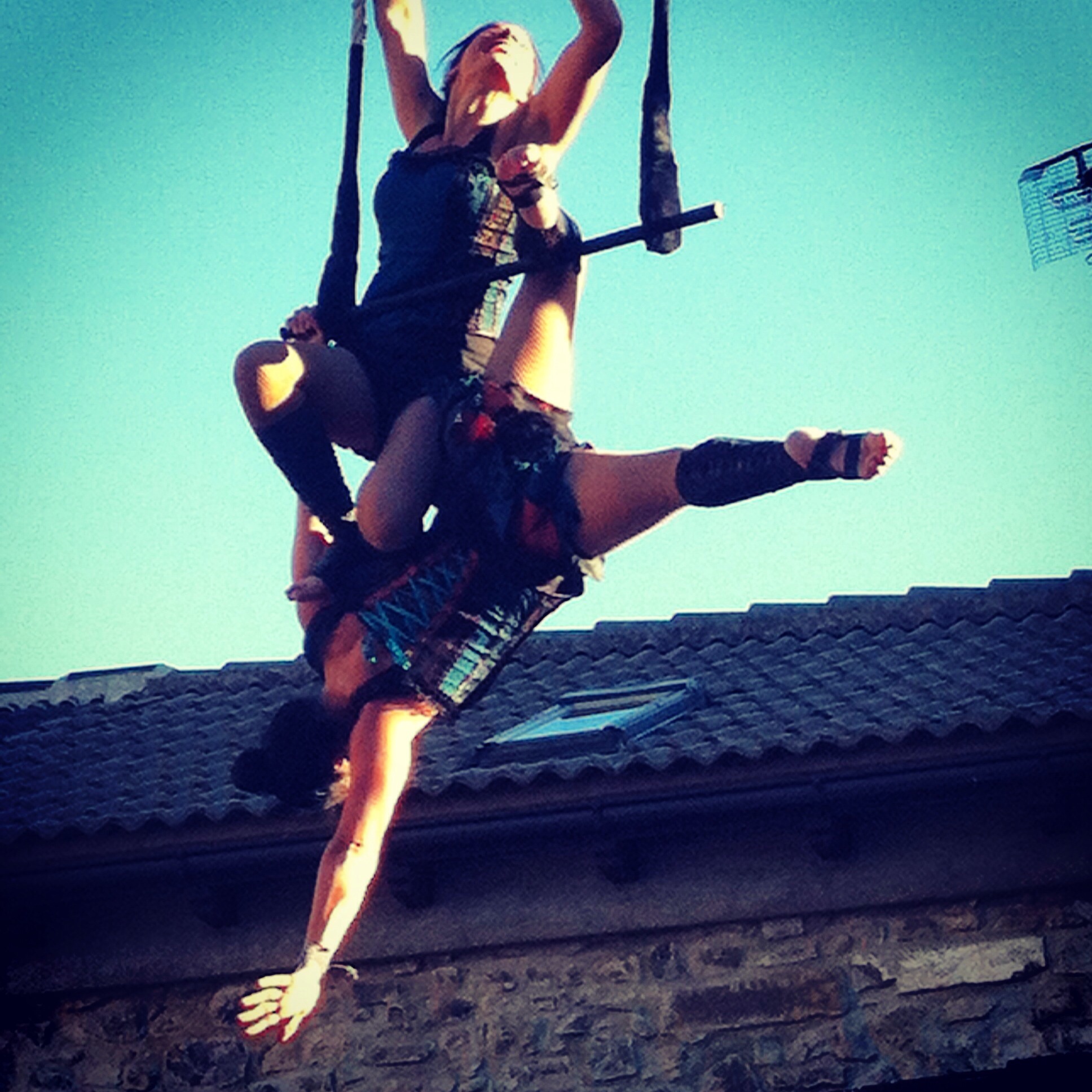
At the tiniest Plaza Major I’ve come across in Spain so far, the decor is set for a circus festival. It uncommonly consists of three seperate artist ensembles, travelling together but each one performing on their own stage. So we find ourselves in between three different stages at three different sides of the little square plaza, already packed to the fullest with local and visiting Spanish families. The peaceful and impressive backdrop of rising mountains under a bright blue late-afternoon sky is pretty overwhelming. To me that is. The people around me are not for a moment being distracted from their cheerful chatting and laughing. Until the spectacle takes off and we’re soon all being dazzled by trapeze work, acrobat acts, music from the soundtrack of Grease and Indian folkoric songs. Twice we’ve got to move by ourselves the wooden benches we are sitting on, turning them into the direction of the following performance, facing the next stage. Acting as sullen spectators, leisurably being entertained by hard working artists, it takes a lot of confusion and unexpected teamwork to get this done. Interactivity at a very basic level, as engaging as it is funny. All this is taking place at the tiniest Main Square (Plaza Major) of the age old village of Villanau (new village), adorned by well kept rustic houses, bright red flowers dangling down from artisinal pottery outside the windows. Romanticism at it’s best.

After I don’t know how much time, the festival finishes. The Spanish quickly resume their laughing and chatting. We’re leaving the enchanted circus scene, happily surprised by the very present and deeply satisfied. A giant bright yellow moon is rising to it’s fullest. That beautiful feminine moon, as overwhelming as the mountains it highlights, is fooler then full tonight.

IMG_3316.JPG

Holy Days II

On a late afternoon I am struck by a most picture perfect #home and country style living# scene. On velvety green grass surrounding a picturesque cottage, I walk up to my host, father of four and owner of four popular London based restaurants. He sits in front of a clay open air pizza oven, shuffling a large stainless steel shovel-like ‘peel’ in and out, sliding baked goods a bit further to and from the fire inside.

He and the pizza oven are set in a private orchard-garden surrounded by lavish green vales and hills. We are talking Dorset, next to rich and beautiful Somerset. At a two hours driving distance from London, sheltered today by blue skies that are finely larded with breezy white strokes.

William Wordsworths’ poem:
I wandered lonely as a cloud
That floats on high o’er vales and hills
When all at once I saw a crowd
A host of golden daffodils…
could have been written exactly here instead of in the Lake District.

A couple of Adirondack or Canadian chairs, typical for Maine, prop perfectly the simple out and about life style. The wooden, elegant yet rustic garden furniture originally from Westport USA was acquired after their last oversees holidays. This morning under a fresh summers’ downpour it was put together by hand. During the same time my friend, fierce- and beautiful mother of the earlier mentioned four, prepared pizza dough, adding some rye flour to consolidate it.

The picture perfect home and country style living scene also depicts seven kids, sitting about the green orchard, devouring their self topped pizzas. Featuring a backdrop like as if turning the next page of that very sensuous magazine: slowly changing colors into orange and purplish.

Hence the kids start to play games involving throwing apples at each other and tossing an egg. Laughing and enthusiastic screams make us turn our heads away from our light-hearted conversation facing the glowing fire in the stone oven. Now turned into dedicated supporters we sit by the kids’ nameless and priceless games. Until around the same time we all decide the game is over. As harmonious as only fiction has it, the seven kids at once run inside to go and watch a movie while we assemble a stack of empty round wooden cutting boards, an empty wine bottle and left over Pellegrino.

While we’re leaving the perfect magazine scene, the sky over the cattle fields and lush green bushes sets on fire. So it seems. The beauty of it not to be pictured nor described. But to imagine!

Holy Days

The word holidays is derived from holy days. The festive Saint days are supposed to be free of work and to be dedicated to a certain Saint in particular (spirituality), to celebrating family life, to engaging into the community or sports and leisure.

Today holidays are pretty much adrift. We preferably dedicate the holy days to escape the (urban) jungle. In order to run around in challenging places where we presumably get to know the whereabouts or ourselves better, gathering as much information and experiences as is possible to digest, given a restricted amount of time and money. Alternatively we sit around drink alcohol, eat for pleasure, have sex and attend extatic parties or attend parties in extatic states of mind.

If the 19th Century has seen the Victorian age of Romanticism, the 21st Century welcomes the era of Escapism. While digitally binding together distant social and geographical environments and having war-zones seem closer to us then the bakery around the corner, our personal whiteboards being attacked daily by real or Nintendo made missiles. We can’t fight back, so we fly. The only other option our neurological sytem designed for us. We fly into many spirit enhancing stuff. Consider the succes of AA societies: Alcohol Anonymous, Cocaïne Anonymous, Interdependancy Anonymous, Obesitas Anonymous, Sex Anonymous. But in non-exagerated, judged-‘normal’-by-society standards we preferably fly away in aeroplanes. Or take the exit in other forms of mobile transportation. We spent a big amount of money, time and energy into our escapes. We actually earn money to make our need to escape ’from it all’ possible.

What happened to the holy days when we no longer believed in Saints? They’ve simply lost their holiness, became trodden path and now serve all sorts of non spiritual purposes. Spending holidays has become as demanding as what our enterprises, employers, employees or simply our society standards expect from us. Is that true? Or is it within ourselves to expect so bloody much, even from our holy days. Maybe the time has come to finally dedicate some of our money, time and energy into something without expecting anything in return. Priceless peace and sacred holy days will be the reward. Isn’t that what we all are looking for.

Do No Harm

‘Do no harm’ voegt Wim toe aan een rijtje van filantropische geefredenen. We zitten op Buitengoed Hagenhorst, een charmant landelijk hotelletje temidden van weelderig groen in één van haar twee bescheiden vergaderruimtes, pal naast de drukke Rijksstraatweg tussen Wassenaar en Den Haag.

We zitten aan de vergadertafel bij Jacqueline Detiger en Luuk van Term die samen een adviesbureau op het gebied van filantropie oprichtten. Vandaag presenteren zij voor het eerst hun basiscursus Beter Geven. Ik ben één van de tien deelnemers, vogels van opvallend diverse pluimage. Een doorgewinterd business development manager bij Cordaid zit tegenover de sinds een paar jaar ‘financially free’ neef Luuk met ernaast zijn tante die een substantiële erfenis ontving en zich nu oriënteert op de besteding (van een gedeelte) ervan aan Goede Doelen.

Eerder vanmorgen op het schoolplein in Amsterdam-West waar ik mijn kinderen achterliet, vertelde ik enthousiast aan een collega moeder dat ik me verheugde op de cursus Filantropie van vandaag. Ze keek me aan en zei, ‘Oh ja, filantropie wat is dat ook alweer? Postzegels toch?’

Wat is filantropie? Het antwoord op die vraag is voor de meeste deelnemers vandaag overbekend en saai terrein. Maar kennis uitdragen over filantropie is nu juist wel de belangrijkste reden voor het oprichten van adviesbureau Beter Geven: het biedt (potentiële) gevers onafhankelijk en deskundig advies over geven. Meer kennis bij de gever zorgt ervoor dat een gift beter terecht komt en daardoor een grotere maatschappelijke impact heeft.

Aan de Vrije Universiteit van Amsterdam is er de postdoctorale opleiding Filantropische studies. Op HBO niveau is er de Hoge School Windesheim. Verder zijn er in Nederland een (opmerkelijk prijzig) vakblad Filantrofium, een digitale databank van filantropische instellingen en er is SPIN, een netwerk voor ZZPers in de filantropie.

Filantropie is economisch gezien een sector, ze opereert op lokaal, nationaal en internationaal niveau en valt verbazend genoeg onder het Ministerie van Justitie. Een constatering die wordt gerelativeerd met de opmerking dat filantropie zeker ook bijdraagt aan terrorisme bestrijding. Toepasselijk of niet: voorlopig is het een ‘zaak van Justitie’. Maar als het aan Jacqueline Detiger ligt niet meer voor lang.
Vanmorgen vangt aan met het uitdagende adagium: vrijwillig geven van geld, producten en/of expertise (tijd) is een vak. Het uitgangspunt is: Geven is een Vak.

En vandaar Wim’s uitspraak ‘do no harm’. We kennen misschien allemaal wel van die foute liefdadigheidsvoorbeelden. Het oprichten van een weeshuis in een werelddeel waar kinderen gebruikelijk worden opgevoed door opa’s, oma’s of broers en zussen omdat pa en ma afwezig zijn. Of dat nu is omdat ze ‘ergens anders’ de kost verdienen, ziek of overleden zijn, maakt voor de gewoonte niet door pa’s en ma’s opgevoed te worden, in feite niet uit. Wij westerlingen faciliteren het fenomeen weeshuis. Iets wat niet thuishoort in de lokale samenleving. Het door westerlingen gefinancierde weeshuis dient ook nog eens te voorzien in door Westerse ogen gekwalificeerde menswaardige behoeften aan eten, educatie en ziekenzorg. Het weeshuis ontpopt zich per ongeluk als een hoogst begerenswaardige verblijfplaats en de lokale bevolking zal er alles (!) aan doen er zoveel mogelijk kinderen onder te brengen.

Als je ooit in een lokale Aziatische shopping mall ben geweest en de huizenhoge bergen net nieuw uit de fabriek geperste, belachelijk goedkope T-shirts hebt aanschouwd – waardeloos uitschot van de textielproducerende industrieën in lage loonlanden – hou je maar snel op met het deponeren van oude kleding in de containers van het Leger des Heils. Opgelucht, want in de wetenschap dat bij het koffiehuis op de hoek Haarlemmerstraat / Nieuwe Prinsengracht jouw oude ingeleverde kleding wordt aangeboden aan Amsterdamse daklozen, kun je je dan in ieder geval wat dat betreft een ‘do no harm’ filantroop wanen.

Advies geven over goede doelen, voorlichting en ondersteuning met projectmanagement of coaching dat is wat Beter Geven doet.

Mijn aandacht blijft even hangen bij een mooi citaat van Winston Churchill:

‘we make a living by what we get
we make a life by what we give’

63.000 van de 360.000 stichtingen die Nederland telt zijn Algemeen Nut Beogende Instellingen. Ze hebben de zogenaamde ANBI status. ANBI is een fiscale status die de belastingdienst verleent. Iedere stichting an sich opereert zonder winstoogmerk. Maar aan een ANBI instelling kun je geld schenken, honderd procent aftrekbaar van de belasting. Hoe lang deze regeling nog zal bestaan is niet duidelijk. De fiscus is er bij gebaat hier een einde aan maken. Filantropisch Nederland niet. Op dit moment besteedt de gemiddelde Nederlander ruim tweehonderd euro per jaar aan Goede Doelen en de vermogende, dus ook veel meer belasting betalende, Nederlander zit op ruim vijfduizend euro per jaar.

Impact is in de wereld van de filantropie en daar niet alleen, de sleutel. Dat is de trend, leren we vandaag. Het meten van resultaat staat een beetje haaks op een idealistische overweging om geld, goederen en expertise vrijwilig te schenken. Maar begrippen als ‘venture philantrophy’ en ‘social impact philantrophy’ winnen aan populariteit. Ook hier klinkt het economisch verantwoorde ‘Return on investment’ steeds harder. Weliswaar met de S van ‘social’ ervoor. SRI ‘Social Return on Investment’, daar doen we het voor. Sociaal met een hoofdletter S niet in de zin van je eigen sociale omgeving of jouw positie/status daarin. Maar de sociale impact op onze lokale, nationale of internationale ‘civil society’: de betere leefomgeving.

Na de lunch worden we verdeeld in twee families. De opdracht voor beide groepjes is een vermogensfonds oprichten. De thema’s zijn voorop gesteld. Denk bijvoorbeeld aan onderwijs, kinderen en spiritualiteit. Dit onderdeel wordt door familie één met groot enthousiasme aangepakt. Familie twee herbergt de doorgewinterde liefdadigheidsprofessionals. Zij werken de opdracht uit met de nodige scepsis. Met een zich terugtrekkende overheid zien ze de operationele budgetten ras afnemen. Binnen de grote organisaties moeten expertise en know how plaats maken voor commerciëel ingestelde functionarissen. De filantropische wereld bevindt zich in een hartverscheurende spagaat. Zal idealistisch klein initiatief het afleggen tegen de ervaring en assets van de grote organisaties? Wie trekt er aan het langste eind? En waar draait het nu eigenlijk om in filantropische sferen? Ideëele gedrevenheid of jarenlange ervaring?

Het resultaat dat veel, zo niet alle enthousiaste filantropen beogen, komt Jacqueline en Luuk niet zomaar aanwaaien. Met hun dertig jaren staat van dienst in de filantropische sector maken zij Een Verschil. Wat vandaag leert is dat Beter Geven absoluut een vak is.

Ik ben Jacqueline en Luuk in het bijzonder en de andere deelnemers in het algemeen enorm dankbaar dat vandaag voor mij het tipje van de filantropische sluier een stuk verder is opgelicht.